
Your Basket is Empty!



A Complete Guide to Understanding Tyre Size Markings
Choosing the correct tyre size is one of the most important aspects of vehicle safety and performance. Every vehicle manufacturer specifies a tyre size that has been carefully selected to provide the ideal balance of handling, braking, fuel efficiency, ride comfort, and load-carrying capability. Fitting tyres that do not meet the recommended specifications can negatively affect steering response, speedometer accuracy, suspension performance, and overall road safety.
Although the markings on a tyre sidewall may appear confusing, they provide valuable technical information about the tyre's dimensions, construction, load capacity, and speed capability. Understanding these markings helps motorists make informed decisions when replacing tyres and ensures their vehicle continues to perform as the manufacturer intended.
At YE CORNER TYRES LTD, we supply and fit tyres for all makes and models, helping customers choose the correct tyre size based on manufacturer recommendations and driving requirements.
What Is a Tyre Size?
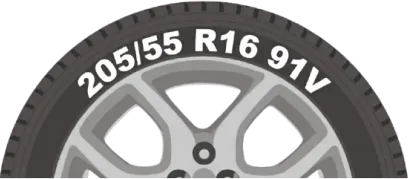
A tyre size is a combination of numbers and letters printed on the tyre sidewall that identifies the tyre's physical dimensions and performance specifications.
A typical tyre size may appear as:
225/45 R17 94W
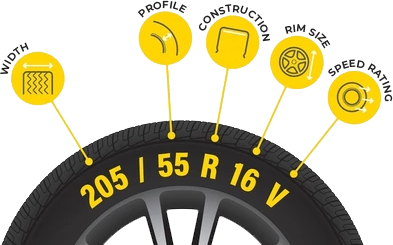
Each part of this code provides important technical information.
Understanding Tyre Size Markings
Tyre Width
The first number represents the tyre width in millimetres.
Example:
225/45 R17
The 225 indicates the tyre is 225 mm wide from sidewall to sidewall when correctly fitted and inflated.
Tyre width influences:
- Road grip
- Braking performance
- Steering response
- Fuel efficiency
- Rolling resistance
Wider tyres generally provide greater grip but may also increase fuel consumption due to a larger contact patch.
Aspect Ratio (Profile)
The second number indicates the tyre's aspect ratio.
Example:
225/45 R17
The 45 means the sidewall height is 45% of the tyre's width.
In this example:
45% of 225 mm = 101.25 mm.
Lower-profile tyres provide:
- Sharper steering
- Better cornering stability
- Improved handling
Higher-profile tyres generally offer:
- Greater ride comfort
- Better shock absorption
- Improved protection against pothole damage
Construction Type
The letter following the aspect ratio identifies the tyre's construction.
R = Radial Construction
Nearly every modern passenger vehicle uses radial tyres because they provide:
- Improved durability
- Better fuel efficiency
- Longer tread life
- Enhanced handling
- Lower rolling resistance
Older cross-ply tyres are now rarely used on passenger vehicles.
Wheel Diameter
The next number indicates the wheel diameter measured in inches.
Example:
225/45 R17
This tyre fits a 17-inch alloy or steel wheel.
The tyre diameter must always match the wheel diameter exactly.
Load Index
Following the wheel diameter is the load index.
Example:
225/45 R17 94
The load index represents the maximum weight that one tyre can safely support.
Every load index corresponds to a specific maximum load capacity.
Using tyres with a lower load rating than recommended by the manufacturer can affect:
- Vehicle stability
- Safety
- Insurance compliance
- Tyre durability
Always select tyres that meet or exceed the manufacturer's specified load index.
Speed Rating
The final letter represents the tyre's speed rating.
Example:
225/45 R17 94W
The speed rating indicates the maximum speed the tyre has been designed and tested to sustain safely under specified conditions.
Common speed ratings include:
| Speed Rating | Maximum Speed |
|---|---|
| T | 118 mph (190 km/h) |
| H | 130 mph (210 km/h) |
| V | 149 mph (240 km/h) |
| W | 168 mph (270 km/h) |
| Y | 186 mph (300 km/h) |
Replacement tyres should always meet or exceed the manufacturer's recommended speed rating.
Extra Load (XL) Tyres
Some tyres include the marking:
XL
This stands for Extra Load.
These tyres have reinforced construction allowing them to carry heavier loads at higher inflation pressures.
XL tyres are commonly fitted to:
- SUVs
- Electric vehicles
- Performance cars
- Vans
If your vehicle originally uses XL tyres, they should normally be replaced with equivalent XL-rated tyres.
Run Flat Tyres
Some vehicles are fitted with Run Flat Tyres (RFT).
These tyres feature reinforced sidewalls that allow limited driving after a puncture.
Benefits include:
- Continued mobility after pressure loss
- Improved safety
- No immediate roadside tyre change
Run flat tyres should only be fitted to vehicles designed for them unless the manufacturer advises otherwise.
Why the Correct Tyre Size Is Important
Choosing the wrong tyre size can significantly affect vehicle performance.
Incorrect tyre sizes may cause:
- Poor handling
- Reduced braking efficiency
- Increased fuel consumption
- Incorrect speedometer readings
- Suspension interference
- Premature tyre wear
- Increased steering effort
Even small changes in tyre dimensions alter the rolling circumference, affecting electronic safety systems such as ABS and Electronic Stability Control (ESC).
Where Can You Find Your Tyre Size?
Your vehicle's recommended tyre size can usually be found:
- On the existing tyre sidewall
- Inside the driver's door frame
- On the fuel filler flap
- In the vehicle owner's manual
- On the manufacturer's information plate
Many vehicles also have different approved tyre sizes depending on wheel specification and trim level.
Can You Change Tyre Size?
Changing tyre size may be possible, but only within manufacturer-approved tolerances.
Factors that must be considered include:
- Overall rolling diameter
- Wheel width
- Load index
- Speed rating
- Suspension clearance
- Steering geometry
- Speedometer calibration
Before fitting an alternative tyre size, professional advice should always be obtained to ensure compatibility and safety.
Professional Tyre Fitting Matters
Even if the correct tyre size has been selected, professional fitting is essential to ensure optimum performance and safety.
At YE CORNER TYRES LTD, every tyre fitting includes:
- Professional tyre installation
- Electronic wheel balancing
- Tyre pressure adjustment
- Valve replacement or TPMS servicing
- Correct wheel nut torque
- Comprehensive tyre safety inspection
If uneven tyre wear is identified, we also recommend a professional wheel alignment check to maximise tyre life and maintain accurate steering.
Why Choose YE CORNER TYRES LTD?
At YE CORNER TYRES LTD, we understand that choosing the correct tyre size is essential for maintaining your vehicle's safety, performance, and efficiency. Our experienced technicians are always available to help you identify the correct tyre size, explain load and speed ratings, and recommend the most suitable tyres for your vehicle and driving requirements.
Located at 176 Rickmansworth Road, Watford WD18 7JS, we stock a wide range of premium, mid-range, and budget tyres for cars, SUVs, vans, and light commercial vehicles.
Alongside professional tyre fitting, we also offer wheel balancing, wheel alignment, puncture repairs, TPMS servicing, and 24-hour mobile tyre fitting.
Whether you require a single replacement tyre or a complete new set, YE CORNER TYRES LTD is committed to providing expert advice, quality workmanship, and outstanding customer service every time.